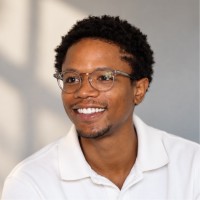
How I think
I ask one more question.
The interesting answer is often hiding just past the obvious one. Curiosity keeps me open to finding it.
I’m curious about people: what makes us tick, what helps us feel like we belong, and what becomes possible when the systems around us work better for everyone.
The short version: I ask questions, listen for what’s underneath the obvious answer, and care about what happens to the people living with the outcome.
That’s true in my work, and it’s a pretty good guide to me as a person, too.
I’m still becoming, and I don’t think a title can tell the whole story. These are a few better clues to how I move through the world.
The interesting answer is often hiding just past the obvious one. Curiosity keeps me open to finding it.
I pay attention to who a system makes room for—and who has to work around it. People should never be an afterthought.
I try to stay honest about what I know, empathetic about what others experience, and persistent about making things better.
I believe the way people experience a system tells you whether it’s working. Understanding those experiences isn’t a detour from progress; it’s how we make progress that lasts.
Take the time to understand people deeply enough to create better outcomes.
Profitable Patience is the belief that understanding people is not a delay to progress. It is often what makes progress possible.
Organizations can become so focused on speed that they overlook the information hiding inside human experience: what people need, what they value, what motivates them, and what prevents them from participating fully.
I believe there is measurable value in slowing down long enough to understand those things. Patience creates understanding. Understanding creates trust. Trust creates participation. Participation creates insight. Better insight leads to better decisions—and better decisions expand the possibilities for both people and organizations.
I work across human behavior, strategy, technology, and innovation to create the conditions for people to participate fully, contribute meaningfully, and prosper.
To build systems, experiences, and ideas that help people feel understood, empowered, and capable of pursuing greater possibilities.
A future where listening, empathy, and psychological safety become inputs into better decisions, stronger organizations, and more useful technology.
Curiosity is not a standalone value. It is the connective force that gives each value greater depth—shaping how I question assumptions, understand people, test ideas, and make decisions.
Patience is the discipline to resist premature conclusions. It creates room for better questions, fuller context, and the curiosity required to see beyond the obvious answer.
The more curious I am about my own motivations, assumptions, strengths, and ambitions, the more intentionally I can choose where to place my energy.
Curiosity identifies possibility. Tenacity gives it momentum. The most meaningful opportunities rarely arrive with a complete playbook.
Empathy is curiosity extended toward another person. It turns perspective into better leadership, better design, better communication, and better decisions.
My work spans employee experience, people strategy, and emerging technology. I look for ways to understand what people need and help make the systems around them work more clearly.
The titles changed. The pattern became clearer: understand people, understand the system around them, then improve how the two work together.
I began my career studying experience at scale through Walmart’s belonging and inclusion work.
I helped develop measurement strategies across more than 35 initiatives and translated over 250,000 data points into insights leaders could use to understand whether programs were creating meaningful impact.
The experience reinforced a principle that continues to shape my work: listening matters, but listening becomes more powerful when organizations build systems capable of learning from what they hear.
Human Resources Business Partner — Membership, Marketing, Product & Design
Four years as an HR Business Partner became one of the most formative chapters of my career.
The role placed me at the intersection of the business, the people inside it, the leaders responsible for it, and the systems connecting all three. Across Membership and Marketing, I built career-development programming for 5,500 field associates, created self-service HR experiences, and used workforce analytics to inform engagement and talent decisions.
Supporting Product and Design brought me even closer to business strategy. I partnered with seven senior executives across a 350-person innovation organization and supported the people strategy surrounding a $95M wage portfolio.
The value of the HRBP experience extended beyond any individual deliverable. It gave me visibility into how organizations actually operate—from everyday employee experience to executive decision-making.
I learned to see the organization as a system. People decisions affect business decisions. Business decisions affect experience. Experience influences behavior. Behavior ultimately shapes performance.
My HRBP experience eventually led toward a broader question: if organizations are systems, how might technology improve the way those systems work for people?
I designed and scaled a 12-week AI fluency program across the Sam’s Club People organization, contributing to 98% AI adoption while helping associates translate emerging technology into practical ways of working.
My work expanded into agentic AI discovery, digital associate-experience strategy, predictive analytics, feedback systems, and advising senior leaders on AI adoption, digital ethics, and people enablement.
The technology changed. The underlying question did not: how can we understand people and organizations deeply enough to build something that genuinely improves how they operate?
These examples show how I translate human friction and organizational complexity into practical, scalable outcomes.
Emerging AI tools were moving faster than consistent organizational confidence, capability, and adoption.
Adoption is a human behavior problem before it is a technology problem.
Designed and scaled a 12-week AI fluency program for 85+ associates and helped translate AI into practical work patterns.
98% AI adoption, measurable productivity uplift, and a stronger foundation for broader AI enablement.
Complex organizations require people decisions that remain tightly connected to business priorities.
HRBP work offers a rare view of the organization as a system—from frontline experience to executive decision-making.
Partnered across Membership, Marketing, Product and Design, including seven senior executives and a 350-person innovation organization.
Supported a $95M wage portfolio and advised across talent, engagement, performance, and workforce decisions.
Thousands of field associates needed a clearer, more scalable path to development and internal mobility.
Development systems work when they are simple enough to use and relevant enough to matter.
Designed a career-development program for 5,500 field associates and supported scalable talent frameworks.
93% completion within three quarters, alongside improved internal mobility metrics.
Inclusion efforts require more than intention; leaders need evidence that programs are producing meaningful experience change.
Listening becomes more powerful when organizations can measure, learn, and act on what they hear.
Led measurement strategy across 35+ programs, captured 250K+ data points, and later served in enterprise accessibility leadership.
Enterprise insights, stronger inclusion scorecards, and accessibility programming reaching more than 1.6M associates.
I write to make sense of the connections between human behavior, organizational systems, technology, and the decisions that shape how people experience work.
Studying how people make decisions—and what those decisions can teach us about the systems we build.
Neuroeconomics is the lens at the center of my practice and studies. It brings together questions about the brain, behavior, and decision-making to explore how people choose, respond, and assign value.
I’m interested in the forces beneath a decision: how context shapes choice, how people navigate uncertainty, and how trust, incentives, and emotion influence what feels possible.
That curiosity follows me into the workplace. Organizations are full of decisions, big and small, made by people responding to the systems around them. Understanding more about how those decisions happen can help us ask better questions about leadership, technology, and the experience of work.
For me, neuroeconomics is both a field of study and a way to stay curious about people. It helps connect the science of decision-making with the everyday choices that shape how we work and live.
These are some of the questions I return to as I study neuroeconomics and connect it to human behavior, organizational systems, and the future of work.
How adoption, behavior change, and human-machine collaboration influence the way work evolves.
How strategy, culture, incentives, leadership, and operating structures shape behavior.
How cognition, context, and choice influence the systems designed around people.
How trust, access, and participation influence the experience and performance of organizations.
Some of the most important work I have done sits outside a formal role—where influence depends on trust, advocacy, and the willingness to make systems more accessible for the people inside them.
Served as Vice Chair of Walmart’s Disability Action Network Associate Resource Group, helping expand accessibility and inclusion programming across an enterprise of more than 1.6 million associates.
1.6M+ associates reachedSelected as one of 25 national participants for advanced development in corporate accessibility advocacy and inclusive leadership.
1 of 25 selectedRecognized across multiple years for designing people-first systems that improved engagement, accessibility, and workforce experience.
2021 · 2022 · 2023 · 2024 · 2026Empathy is curiosity extended toward another person.
I’m interested in the ideas, people, and experiences that shape how we work and grow. Connect with me on LinkedIn to follow my professional journey.
Connect on LinkedInOne person. One philosophy. Multiple applications.